The Initiation

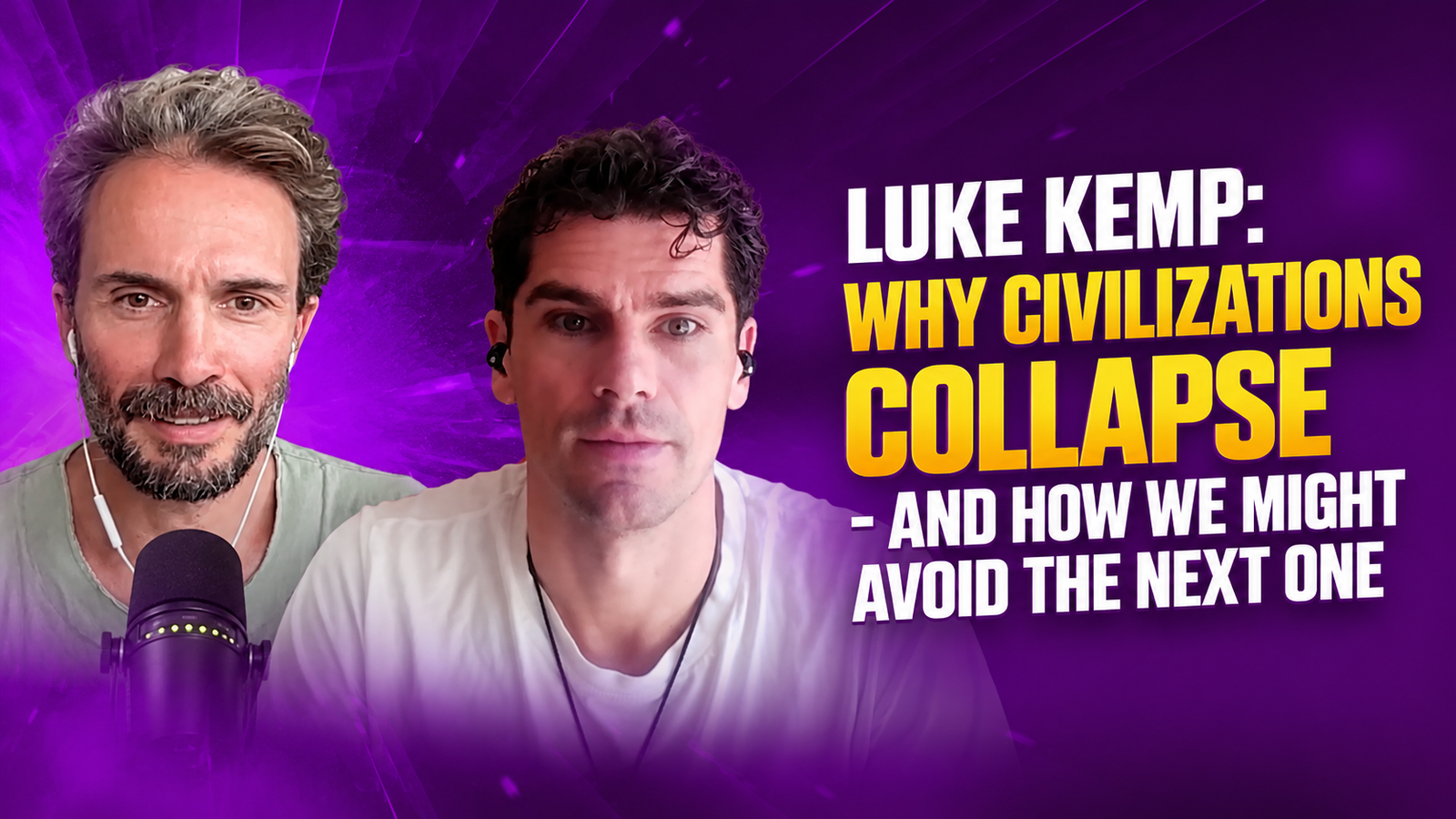
#23 Luke Kemp: Why Civilizations Collapse – and How We Might Avoid the Next One — Podcast Episode
#23 Luke Kemp: Why Civilizations Collapse – and How We Might Avoid the Next One
arrow_back All Episodes

Podcast Episode  ·  Episode 23

#23 Luke Kemp: Why Civilizations Collapse – and How We Might Avoid the Next One

Listen on Links coming soon

Description

In this episode of The Initiation, I speak with Luke Kemp, researcher at Cambridge’s Centre for the Study of Existential Risk and author of Goliath’s Curse: The History and Future of Societal Collapse.

Luke challenges the conventional story of civilization as a steady march of progress. Instead, he traces the rise of what he calls “Goliaths”: societies built upon concentrated power, extractive resources, monopolized violence, and the restriction of people’s freedom to leave.

While the collapse of these systems often benefited ordinary people in the past, Luke argues that collapse today would be profoundly different. Nuclear weapons, artificial intelligence, ecological breakdown, and our dependence on global supply chains have raised the height of the fall – potentially to a terminal level.

We discuss:

  • Why the earliest states resembled organized protection rackets
  • The three ingredients that allow Goliaths to emerge
  • Why fear makes societies vulnerable to authoritarian leaders
  • How inequality and concentrated power make civilizations fragile
  • Why collapse had a surprisingly bright past – but may have a dark future
  • The growing risks posed by nuclear weapons and artificial intelligence
  • Why game theory misunderstands ordinary human behaviour
  • Humanity’s deeper evolutionary capacity for cooperation
  • How corporations and states amplify the darker sides of human nature
  • Citizens’ assemblies, wealth redistribution, and the possibility of open democracy
  • What meaningful action looks like in the face of systemic risk

This is a sobering but ultimately empowering conversation about the history of power, the risks gathering around us, and how we might build institutions that bring out the best- rather than the worst-of humanity.

And for new listeners, Season 1 of The Initiation lays the foundation for this inquiry – exploring the breakdowns, breakthroughs, and inner transformation shaping humanity’s collective threshold.

Keep Listening

Related Episodes

#25 Sheldon Solomon: How the Fear of Death Shapes the World
Episode

Episode 25

#25 Sheldon Solomon: How the Fear of Death Shapes the World

Sheldon Solomon joins The Initiation. Sheldon is a social psychologist and one of the world’s leading researchers on terror management theory, exploring how our awareness of mortality shapes human behaviour. His work examines the hidden influence of death anxiety on tribalism, authoritarianism, status, and environmental destruction — and how confronting mortality through awe, humility, and gratitude might help us live with greater meaning and existential maturity.

#24 Sarah Wilson: How to Live Fully in a Collapsing World
Episode

Episode 24

#24 Sarah Wilson: How to Live Fully in a Collapsing World

Sarah Wilson joins The Initiation. Sarah is a bestselling author, journalist, and activist whose work explores how we can live meaningfully amid uncertainty and civilizational change. Her latest book, I Eat the Stars: How to Live Fully and Beautifully in a Collapsing World, examines the metacrisis, our relationship with hope, and how nature, community, spirituality, and even joy can help us navigate a world in profound transition.

#22 Corey Bradshaw: Extinction, Overpopulation, and the Future We Can Still Shape
Episode

Episode 22

#22 Corey Bradshaw: Extinction, Overpopulation, and the Future We Can Still Shape

Corey Bradshaw joins The Initiation. Corey is an ecologist, modeller, and global change scientist whose work explores extinction, population dynamics, climate change, and the future of human civilisation. Through ecological data and mathematical modelling, he confronts the realities of biodiversity loss, overconsumption, and environmental breakdown — while asking how we can face an uncertain future with greater honesty, resilience, and responsibility.

Stay Oriented

Receive essays, reflections, and new episodes directly in your inbox.


    No spam. Unsubscribe anytime.